
Small‑scale peristaltic filler for eye drops and essential oils. Microcomputer control sets the volume; product only contacts tubing for fast, hygienic changeovers.
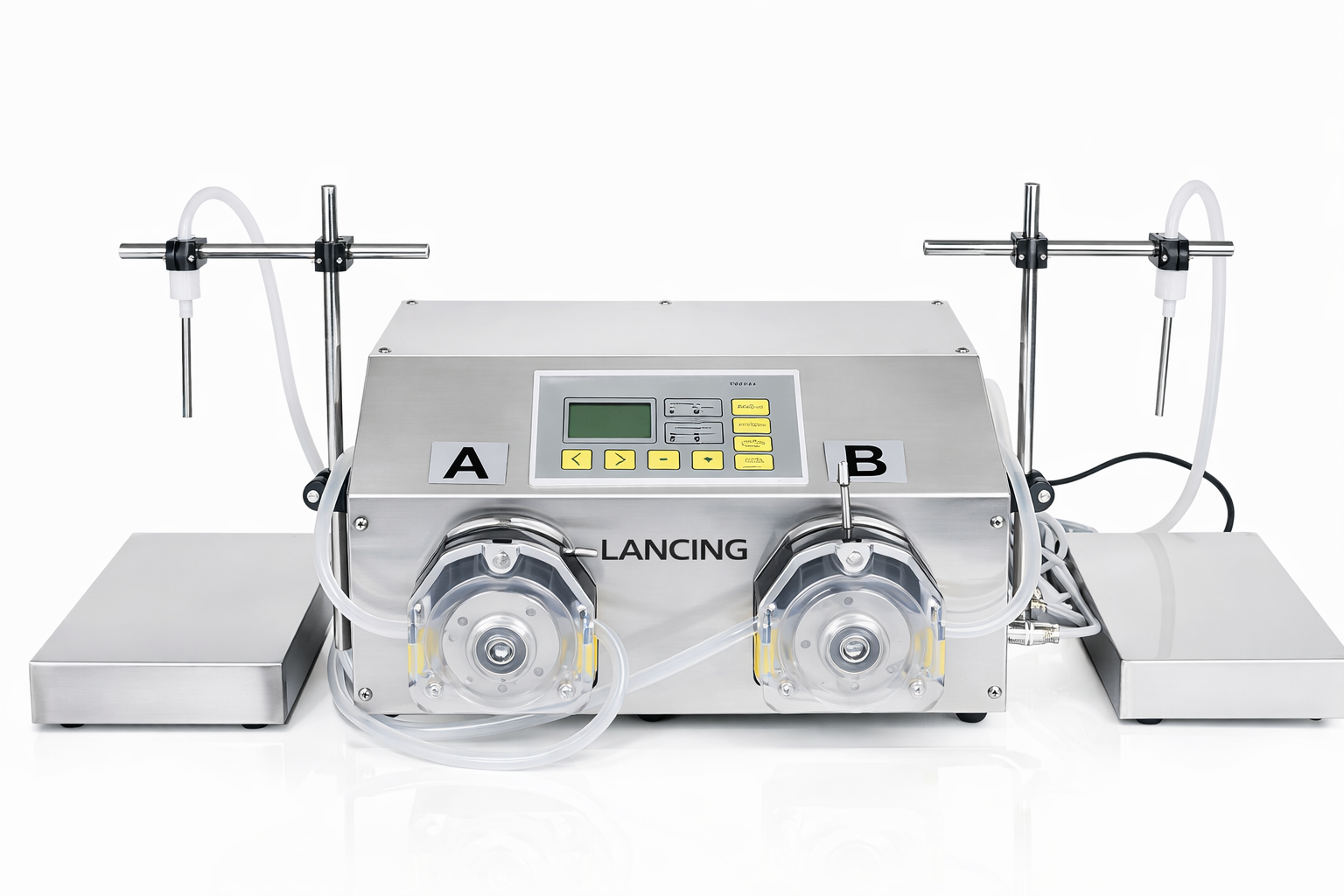
Maintain product purity—liquid never passes through the pump body.
Set volume precisely; repeatable cycles.
Flexible power selection.
Easy to place on a bench or under a hood.
Choose the trigger mode that suits operators.
Fast product changeovers between SKUs.
Performance depends on product, container, and setup. Ask us for a timed trial.
Eye drops and sample vials.
Essential oils and serums.
Flavour concentrates (compatible).
Tell us about your application. We’ll confirm compatibility and quote the best configuration.
Small-volume liquid filling
This semi-automatic peristaltic filler keeps the liquid within replaceable tubing and provides foot-pedal or automatic triggering. Suitability still depends on the selected tubing, product behaviour, dose range, nozzle, container and the way the operator calibrates and changes the setup.
The tubing is the product path, so its material and internal diameter affect chemical compatibility, flow and repeatability. Provide the actual liquid and its normal temperature. Where several products are planned, check every formulation rather than assuming one tube material will suit the complete range.
Small doses need a stable prime, controlled start and clean cut-off. Larger or more viscous fills may require a different tube size, pump speed or filling method. The intended minimum and maximum dose should be trialled, not only the most common setting.
Container neck size, nozzle position, hose length and the height difference between product supply and nozzle can influence the cycle. The hose should be routed without kinks or uncontrolled movement, and the nozzle should allow air to leave the container while limiting splashing or dripping. If the liquid tends to foam or string, the fill profile and cut-off need practical assessment.
Peristaltic systems are attractive for product changeover because the hose can be replaced, but that does not remove the need for a repeatable procedure. Record the tubing specification, pump setting, prime sequence and calibration check for each product. Operators should also know when a worn or flattened tube needs replacement.
| Quotation input | Reason for checking it |
|---|---|
| Liquid and normal temperature | Confirms tubing compatibility and expected flow behaviour. |
| Minimum, normal and maximum dose | Shows whether one tube and control range can cover the application. |
| Container and neck dimensions | Determines nozzle size, position and operator access. |
| Required cycles and batch length | Helps assess whether a semi-automatic bench machine is the right automation level. |
| Changeover and cleaning method | Defines tubing replacement, priming and verification steps. |
A peristaltic filler may not be the best choice where the liquid is too viscous for the proposed tubing, contains particles that cannot pass safely, requires a much larger flow or reacts with available hose materials. Compare the wider liquid filling range, including higher-flow semi-automatic peristaltic filling, compact multi-head peristaltic filling and automatic peristaltic filling.
A representative trial should measure repeated fills after priming, after a pause and as the supply level changes. This confirms the operating method and identifies whether additional supports, drip trays or nozzle fixtures are needed for the actual pack.
Have a small-volume liquid and bottle ready? Send both with the dose range and expected batch size for a practical configuration review.
Discuss this peristaltic fillerIn a peristaltic system the pump acts on the outside of the tube, so the liquid path is contained within the selected tubing and connected nozzle. Compatibility of the complete wetted path still needs to be confirmed.
Selection depends on chemical compatibility, liquid temperature, viscosity, required flow, dose and the pump head. A representative liquid sample and the complete fill range are needed for confirmation.
It can be configured for different compatible liquids, but each product may need its own tubing, prime, calibration and stored operating procedure. Every formulation should be checked rather than grouped by product name.
Tubing size and condition, priming, liquid viscosity, supply head, hose routing, nozzle cut-off and the programmed cycle can all influence repeated fills. Testing should include pauses and restarts.
Automatic equipment is worth considering when containers need conveyor handling, multiple filling heads or a higher sustained output. Batch size, labour, container stability and integration with capping and labelling should be compared.
© Copyright 2025 by Lancing Ltd - all right reserved terms & conditions