Liquid dosing selection
Compare piston, peristaltic and pump routes for the product.

Compact vertical form‑fill‑seal for liquids and sauces. Piston pump dosing, 80 L stirred hopper and multiple seal styles deliver retail‑ready sachets.
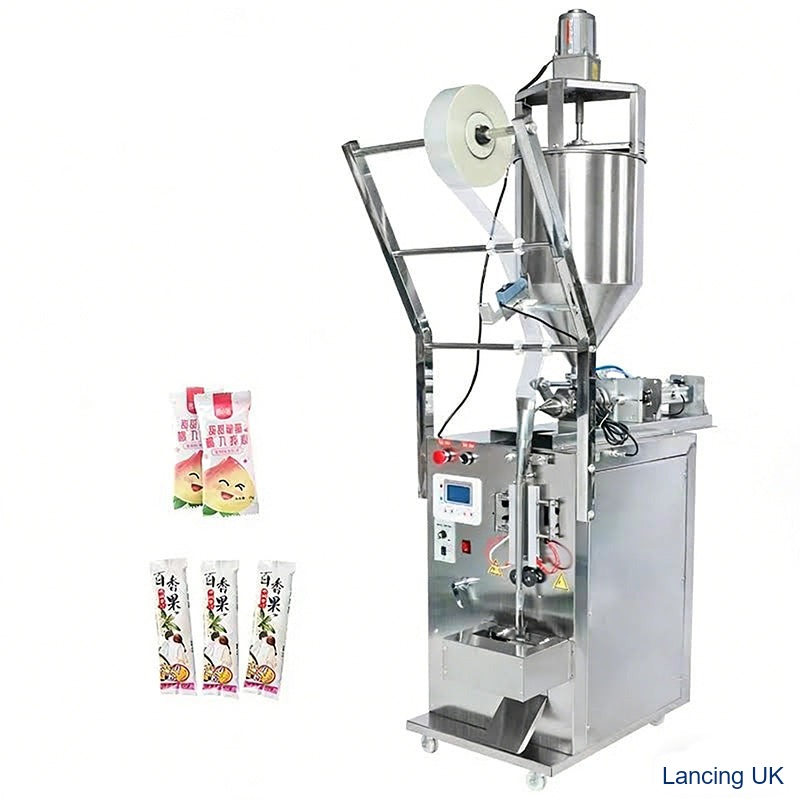
5–100 ml recommended range with stable accuracy (±1–2 ml).
Optional heating for hard‑to‑flow products.
Back seal; three‑side or four‑side seals available.
Tracks film marks for precise cutting and alignment.
Temperature‑controlled bars suit PE/PP & laminated films.
≈580 × 1100 × 1750 mm, ~95 kg.
Performance depends on product, container, and setup. Ask us for a timed trial.
Sauces, honey, condiments, syrups.
Gels, lotions, sample sachets.
Detergent gels and cleaners (check viscosity).
Tell us about your application. We’ll confirm compatibility and quote the best configuration.
Liquid sachet application
The machine combines piston-pump dosing with vertical pack forming and sealing. The existing configuration includes an 80 litre hopper with mixer, colour-mark sensing and adjustable sealing, but the final setup must be proven with the actual liquid, film, dose and finished sachet dimensions.
The piston dosing route should be checked against viscosity, temperature, particles, separation and foaming. The mixer can help maintain a consistent product where appropriate, but mixing speed and dwell must not damage the formulation or introduce air. The nozzle and timing must place the dose below the future seal area.
Film width, stiffness, friction and seal layer affect tracking around the former and through the jaws. Printed film also requires the registration mark to be compatible with the sensor and artwork repeat. The supplied reel material must be trialled at the intended pack size and production conditions.
Liquid on the sealing faces can prevent a consistent closure. Splashing, product stringing and movement of the forming tube should therefore be checked with the real product. Dose timing, headspace, cut-off and sealing sequence may need to be balanced against output. A visually closed sachet should be allowed to cool and then assessed for leakage and handling damage.
The specified seal style must match the film and finished-pack requirement. Confirm sachet width, cut length, fill position, headspace, print orientation and coding area before artwork or reel dimensions are fixed. Where multiple pack sizes are planned, identify which parts and settings change and how long the production team can allow for changeover.
| Trial item | What to confirm |
|---|---|
| Representative liquid | Flow, separation, particles, foaming, stringing and response to hopper mixing. |
| Production film | Tracking, forming, print registration and the sealing window. |
| Dose range | Piston setup, fill timing, headspace and repeatability at the smallest and largest fill. |
| Finished sachet | Dimensions, appearance, seal continuity, leakage and downstream handling. |
| Line interfaces | Product feed, coding, discharge conveyor, inspection and case-packing requirements. |
This machine forms the sachet from reel material. If the project requires a shaped, gusseted or otherwise specialist pre-made pack, compare the pre-made pouch filling machine. For other reel-fed formats, review the VFFS category and the broader sachet filling range.
Provide the product, proposed film reel or material data, finished sachet drawing, dose range, target output, utilities and available floor space. Include any coding, checkweighing or downstream conveyor requirement. A timed sample trial is the appropriate way to confirm the practical rate and seal quality for the selected combination.
Ready to test a liquid sachet format? Send the product, film and finished-pack dimensions together so dosing and sealing can be reviewed as one process.
Request a liquid VFFS reviewTest the actual formulation at its normal filling temperature, including any particles, separation or viscosity variation expected in production. The dosing and sealing cycle should be proven with the proposed film.
Film structure affects forming, tracking and sealing. Printed film also confirms registration-mark sensing and artwork position. A substitute material may not behave the same way as the production reel.
The nozzle, dose timing, headspace and product cut-off are adjusted so the liquid enters below the sealing zone. Products that splash, foam or string need a representative trial to confirm the sequence.
A range may be possible, but film width, former, cut length, jaw settings and dosing range must be reviewed for each size. Change parts and setup time should be identified before quotation.
A pre-made pouch route may be more suitable for shaped or specialist pouches that are not formed from a simple reel on the VFFS machine. Reliable pouch pick-up, opening, filling and final sealing still need to be tested.
Liquid sachet project resources
The existing page describes this liquid VFFS application. Final suitability should be confirmed with the actual product, production film and finished-sachet acceptance method.
Describe viscosity and flow at filling temperature, particles, foaming, separation and product compatibility with the proposed contact path. Define the normal and extreme dose, sachet dimensions, film structure, print registration and allowable product-free seal zone. Include the approved method for checking dose and seal performance.
Use enough material to establish stable dosing and sealing, then test repeated starts, replenishment and the difficult product condition. Record lane or channel results where relevant. If the product contaminates the seal area, the trial should investigate fill timing, cut-off, headspace and presentation rather than compensating only with extra heat.
Compare piston, peristaltic and pump routes for the product.
Define finished pack, material and seal acceptance.
Prepare product, film and measurable evidence.
Ready to discuss the application?
Send the application details to Lancing for a tailored machinery review.
Liquid sachet material and dosing detail
Provide the liquid at its production temperature, intended dose range, final web construction, print registration, sachet dimensions and an accepted seal and quantity test. Include start-up and stop conditions because splashing, wicking or delayed nozzle cut-off can affect the seal area differently from steady operation.
© Copyright 2025 by Lancing Ltd - all right reserved terms & conditions